Saturday, October 20, 2012

Modern day Hayden Flour Mill - outside walking tour

The Hayden Flour Mill was booming after WWII and we learned so much about Tempe history at the Mill on Thursday. Thanks to our great tour chair Mary Garbaciak, we were able to walk all around the building while listening to ASU architect Mark Vincent tell us insider stories.  The new photo/informational lighted signs are also most informative.

Did you know that the Mill is considered Ground Zero for Tempe? All addresses start there.

We are so grateful the City of Tempe owns the building and is working on gaining Historical Preservation Status. It is a most important landmark for the area.

As a thank you to Mark Vincent, Mary presented him with Tastes & Treasures A Storytelling Cookbook of Historic Arizona.

More photos and stories of our trip inside the Mill coming soon.


Friday, October 19, 2012

Tres Leches Cake

Leche means milk in Spanish. Tres Leches Cake is named for the three milks it is soaked in - sweetened condensed milk, evaporated milk and heavy cream. The heavy cream is also whipped up to use as the topping.

Due to the rich ingredients, it is extremely dense and moist, almost like a custard.

Another favorite cake is Chocolate Icebox Cake, page 80 in Tastes & Treasures cookbook.

Tres Leches Cake

Ingredients:
1 1/2 cups cake flour
1 pinch salt
1 teaspoon baking powder
1/3 cup oil
1 cup sugar
1 teaspoon vanilla extract
5 large eggs
1/2 cup whole milk

Directions:
Combine flour and baking powder and salt. In a separate bowl, combine the oil, sugar, and 1 teaspoon vanilla extract. Add the eggs to the sugar mixture one at a time until well combined. Stir in the 1/2 cup of milk, then gently fold in the flour mixture a little at a time.
Pour batter into a lightly greased cake pan or baking dish and bake at 325 degrees for 30-40 minutes or until it feels firm and an inserted toothpick comes out clean.
Let the cake cool until it feels room temperature. Turn it over onto a platter with raised edges. Pierce cake with a fork 20-30 times. Let it cool in the refrigerator for an additional 30 minutes.

Cream Syrup
12 oz. evaporated milk
14 oz. sweetened condensed milk
1/2 cup heavy cream
1 tablespoon rum or brandy (optional)
Whisk together the three milks and the rum or brandy if you are using it. Slowly pour the liquid over the cooled cake. Refrigerate for 1 hour. Occasionally, spoon the milk runoff back onto the cake.

Whipped Topping
3/4 cup heavy cream
1 teaspoon vanilla
1 tablespoon sugar
In a chilled mixing bowl add heavy cream, vanilla and sugar. Beat on high speed until peaks form. Spread a thin layer over the cake.
Top with a sprinkle of cinnamon or garnish with fresh berries.

Wednesday, October 17, 2012

Catching the Brass Ring


Have you ridden a Carousel lately?

The first carousel at Coney Island, America's first major amusement park, was built in 1876 by Charles I. D. Looff, a Danish woodcarver. The oldest functional carousel in Europe is in Prague (Letná Park). Another style is a double-decker, where there is a huge carousel stacked on top of another.
In the early 20th century, there were approximately 4,000 carousels throughout the United States. By the 21st century, that number had been reduced to 150.

Wheaton Regional Park in Maryland has the Carousel pictured. It was build circa 1913.

Enchanted Island Carousel at Encanto Park in Phoenix was built in 1948, is fully restored and a popular attraction.
Thanks to Wikepedia for this history.

Monday, October 15, 2012

Mesquite - Desert Bread

Is it cheating to use a breadmaker???

It is impressive to think how native peoples existed in the desert for centuries. Using what plants they had, this nutritious bread can be made in your home. But we like to use modern conveniences.


The mesquite tree grows in the desert regions throughout the world, areas not suitable for most agriculture. Mesquite forms fruit of bean-like pods in the fall that have long been a nutritious food source to humans, wildlife and livestock. Mesquite meal, made by grinding the ripened pods into a high protein flour, can be used as either a flour or a spice. Mesquite meal is 100% natural, low in carbohydrates and fat, high in dietary fiber, and naturally sweet.

Desert Mesquite Bread

Put into automatic bread maker according to manufacturer’s directions
Ingredients:
1 1/4 cup warm water
1 package yeast
1/3 cup combined honey and Sorghum
1 cup whole wheat flour
2/3 cup quick oatmeal
1/2 cup mesquite flour
2 tablespoon olive oil
1 1/4 + 2 tablespoon all purpose flour
1/2 teaspoon salt

Directions:
Mix and bake according to manufacturer’s directions. The honey/sorghum could be replaced with mesquite molasses.

from Plants of the Sonoran Desert and Their Many Uses by Don Wells and Jean Groen.

Saturday, October 13, 2012

Food Trucks deliver the goods


October is Food Truck Month.

Every city has them now with delicious new foods. No longer called “Roach Coach” mobile kitchens are bringing lunch, dinner and specialty foods to patrons looking for something a little fun and different.

They are always on the move. Find them in your area using these apps: TruxMap Lite, Eat St, Roaming Hunger.

Track them in Arizona: www.mammatoledo.com and www.rrheartranch.com/Cantina

Mojo Tago, Columbus, Ohio shared their recipe for a tasty Roasted Tomatillo Salsa. Tastes & Treasures A Storytelling Cookbook of Historic Arizona has several Salsa recipes, a favorite is Corn Salsa on page 33

Roasted Tomatillo Salsa
Ingredients:
6 to 8 tomatillos
1 red onion
2 jalapeno (or serrano) peppers (add 1 more if you like it spicier)
4 garlic cloves
1/4 cup vegetable oil
1 bunch cilantro
Salt to taste

Directions:
Preheat oven to 400 F. Peel and wash tomatillos. Peel red onions and cut into quarters. Wash and stem jalapenos. Combine tomatillos, onion, jalapenos and garlic, and spread out in a small roasting pan. Drizzle with oil. Roast in the oven for about 30 minutes; you want to see a little char or browning on the tops of the tomatillos and jalapenos. The garlic should be soft and be brown in spots. Cool.

Place mixture, cilantro and salt in a food processor. Process while slowly adding about 3/4 cup water, to achieve your preferred salsa consistency. You may need to do this in two batches if there is too much for one batch.

Enjoy with tortilla chips, over tacos or with your favorite burrito.

Makes 8 to 9 cups.

Thursday, October 11, 2012

October is National Cookbook Month

Get out your cookbook and try a new recipe. Or tweak an old recipe with new ingredients. You are the chemist in your kitchen.

Here's my favorite recipe for October given to Tastes & Treasures cookbook by League member Kay Holcombe.


GREAT PUMPKIN COOKIES from page 162 Tastes & Treasures cookbook
Ingredients
8 oz (2 sticks) butter, at room temperature
1 cup granulated sugar
1 cup brown sugar, gently packed
2 cups all-purpose flour
1 cup oats
1 tsp baking soda
1 tsp salt
1 tsp cinnamon
1 tsp vanilla
1 egg
1 cup solid-pack pumpkin
2 cups semi-sweet or white chocolate chips

Directions
1.    Preheat oven to 350 F.  Line two sheet pans with parchment paper.  (The paper can be reused- just place the cookies in a different spot or turn the paper over)
2.    In the bowl of an electric mixer place the butter & beat on medium speed until creamy, about 1 minute.  Turn off the mixer, scrape the bowl with a rubber spatula and add the sugars.  Beat on medium speed until light and fluffy, about 3 minutes.
3.    Meanwhile place the flour, oats, baking soda, salt, cinnamon and nutmeg in a medium sized bowl.  Gently stir with a whisk to combine.
4.    Stop the mixer and scrape the bowl.  Turn the mixer on low speed; add the eggs and vanilla, beating until incorporated.
5.    Add the flour in thirds, alternating with the pumpkin. (flour-pumpkin-flour-pumpkin-flour)  After you have added the last of the flour, mix until just combined; do not over mix.  Turn off the mixer and scrape the bowl.
6.    Place a small (walnut) sized scoop of dough 1-2 inches apart on the prepared pans.  You can also scoop the cookie dough with a tablespoon and place it on the sheet pans.
7.    Bake for about 10-12 minutes, or until light brown.
8.    Remove cookies from the oven, allowing them to cool on the sheet pan for a few minutes before transferring to a wire rack to cool completely.

Note:
* ½ t nutmeg (fresh ground, if possible) gives an added taste.
* You can add semi-sweet chocolate chips, raisins or nuts for variety.
* Makes about 6 dozen bite sized cookies.
* Store cookies in an airtight container.

Sunday, October 7, 2012

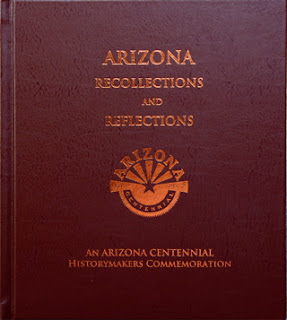
Maricopa Co. Library has Arizona Recollections and Reflections

Susan Dale and Ruth McLeod delivered 17 Centennial Legacy Project books to Mallory Smith this week. We are so pleased to say that all 17 books were underwritten by our sponsors so we were able to donate them to the libraries in this county. These libraries include


Aguila Branch (Aguila, AZ)
El Mirage Branch (El Mirage, AZ)
Fairway Branch (Sun City, AZ)
Fountain Hills Branch (Ft. Hills, AZ)
Gila Bend Branch (Gila Bend, AZ)
Goodyear Branch (Goodyear, AZ)
Guadalupe Branch (Guadalupe, AZ)
Hollyhock Branch (Surprise, AZ)
Litchfield Park Branch (Litchfield Park, AZ)
North Valley Regional Branch (Anthem, AZ)
Northwest Regional Branch (Surprise, AZ)
Perry Branch (Gilbert, AZ)
Queen Creek Branch (Queen Creek, AZ)
Robson Branch (Sun Lakes, AZ)
Southeast Regional Branch (Gilbert, AZ)
Sun City Branch (Sun City, AZ)
White Tank Branch (Waddell, AZ)


In February 2011 the Historical League published  Arizona Recollections and Reflections, An Arizona Centennial Historymakers Commemoration, honoring our Historymakers. A leather-bound 320 page book, it is an important reference for all ages in school and public libraries. The book includes a 56 page timeline that spans pre-statehood to Arizona's 100th year and incorporates the accomplishments of individual Historymakers as well as the book's sponsors during each of the ten decades. Featured in the book are the Historymakers' biographies, formal portraits and candid pictures as well as the histories and photographs of the book's fourteen sponsors.

This book has been well-received by teachers and educators as a reference and resource book. Elementary school students in fourth grade are state mandated to receive instruction in Arizona history. Learning about primary sources and how to analyze individual stories in relation to historical events occurs in middle school. High school students study major changes in society and can relate the effect that had on Arizona Historymakers. www.HistoricalLeague.org/historymakers

We continue to look for sponsors who would like to help us out with this project - getting every school library and public library in the state of Arizona a copy of Arizona Recollections and Reflections An Arizona Centennial Historymakers Commemoration.